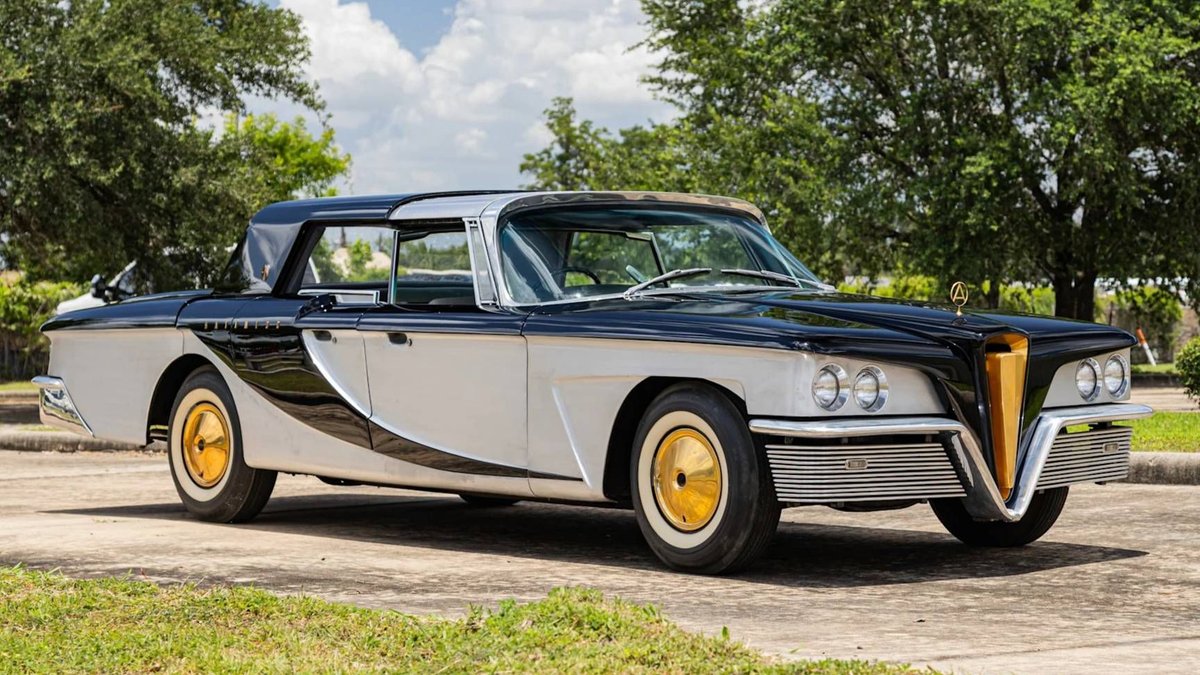
The 1959 Chrysler Scimitar Town Car Phaeton will appear at the Mecum auction in Monterey during Car Week, with an estimated price range of US$150,000 to US$200,000.
Design origins and aluminum showcase
Industrial designer Brooks Stevens created the Scimitar series for the Olin Mathieson Chemical Corporation, which wanted to demonstrate its aluminum‑forming capabilities. The name “Scimitar” reflects the Turkish sword motif that inspired the sharp, blade‑like lines across the body, especially the rear door. The project combined American chassis engineering with European coachbuilding, as German firm Karosseriewerk Reutter in Stuttgart fabricated the aluminum panels.
At the 1959 Geneva Motor Show, the Town Car Phaeton debuted alongside two sister concepts: an All‑Purpose Sedan and a Two‑Door Convertible. All three models featured a pronounced aluminum nose, but only the Town Car version received a gold‑plated arrowhead front. The rear triple lights were borrowed from a contemporary 1959 Chevrolet Impala, adding a familiar touch to the avant‑garde styling.
Related: Bugatti unveils striking one-off Destrier hypercar
Mechanical foundation and interior
Under the striking exterior sits a standard 1959 Chrysler platform. The powertrain is a 350‑horse 413‑cu‑in “Golden Lion” V8 paired with a push‑button three‑speed automatic transmission. The interior retains the original Chrysler layout, with a gray finish that received only minor restyling. The chassis and drivetrain remain largely unchanged from the production model, offering a reliable foundation for the bespoke bodywork.
A notable feature is the roof system, which consists of separate panels over the chauffeur’s compartment and the rear passenger area. Each panel can retract independently, allowing the roof to open over the driver, over the passengers, over both sections, or stay fully closed. This flexibility was marketed as a practical demonstration of aluminum’s versatility in high‑corrosion zones, suggesting potential anti‑rust applications.
Collectors watch eagerly.
Related: Penske Auto to go private in $3.8B deal
Given the car’s rarity and the attention it has attracted at recent concours events, the auction estimate appears realistic. It resurfaced at the 2019 Amelia Island Concours, where it drew interest from collectors who value both its design pedigree and its connection to mid‑century American automotive history.
The blend of American muscle, European craftsmanship, and experimental aluminum work positions it as a unique artifact that could appeal to niche collectors seeking a story‑rich piece rather than a conventional classic. Should the final sale fall toward the higher end of the range, it would reinforce the trend of premium prices for historically significant, low‑production models.
Regardless of the outcome, the auction will add another data point to the evolving valuation of concept cars from the late 1950s. Its presence at Monterey highlights the continued fascination with experimental designs that pushed material boundaries at a time when aluminum was still a novelty in automotive applications. The result will likely influence how similar prototypes are assessed in future classic car markets.


