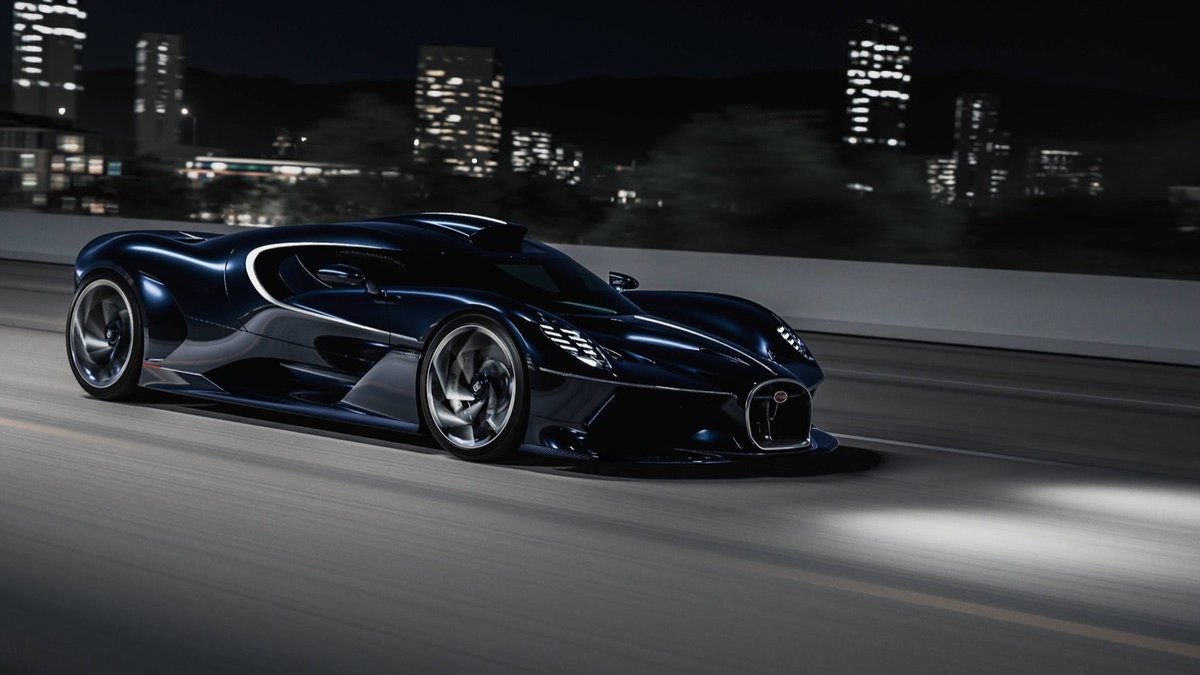
The latest one-off hypercar from Bugatti’s bespoke Solitaire division prioritizes shape over speed.
Unveiled in early August, the Destrier uses the W16-powered Bolide track car as its mechanical foundation but removes the aerodynamic focus in favor of what design chief Frank Heyl describes as “pure sculpture.” The result is the lowest Bugatti ever built—just one meter (39 inches) from ground to roofline—and a body inspired by the marque’s 1930s Type 57SC Atlantic, a model the brand still considers its most beautiful creation.
The Bolide’s bones, the Atlantic’s silhouette
Heyl explains that the Bolide served as the starting point for Bugatti’s most extreme proportions. Without the need for downforce, those proportions were refined into something closer to art. The Destrier’s bodywork, finished in a custom “Sapphire-Celeste” shade, flows in long, smooth curves. A wider horseshoe grille and fenders that hug 20- and 21-inch wheels front and rear give the car a stance Heyl likens to a thoroughbred racehorse.
The interior replaces the Bolide’s minimalist track setup with luxury. Most surfaces feature “Ambre Voyageur,” a warm brown leather and suede combination, while 3D-knitted textile accents add depth. The change reflects a different kind of buyer—one who values presence more than lap times.
Performance remains part of the package. The Destrier keeps the Bolide’s 8.0-liter quad-turbo W16, expected to produce around 1,578 horsepower and accelerate from 0-62 mph in about 2.2 seconds. Yet those figures matter less than the car’s visual impact. Here, the engine exists mainly to support the sculpture.
A private commission, a public debut
The Destrier will appear publicly for the first time at the Pebble Beach Concours d’Elegance in mid-August. Bugatti has not revealed the price, though its one-off projects usually begin in the eight-figure range. The buyer’s identity remains private, but the car’s design suggests a collector more interested in exclusivity than raw performance.
Solitaire has previously reimagined Bugatti models for individual clients. The Brouillard, shown last year, honored Ettore Bugatti’s favorite horse, while the F.K.P. Hommage celebrated the Veyron’s W16 engine. The Destrier stands apart by emphasizing form over function so clearly. It was built to be admired, not driven aggressively.
This approach mirrors a broader trend in hypercar culture, where the most extreme vehicles are now judged more for their ability to draw attention than for track performance. The Destrier’s proportions, rather than its power, define its impact. Its low height demands a second look. The Atlantic’s influence is clear, but the execution feels contemporary, proving that even amid electric hypercars and advanced aerodynamics, some buyers still prefer a car that appears handcrafted from a single block of metal.
The Destrier’s Pebble Beach appearance will likely be its only public showing for years. Like most one-offs, it will join a private collection, representing a unique vision of automotive ambition—one where beauty outweighs speed.


