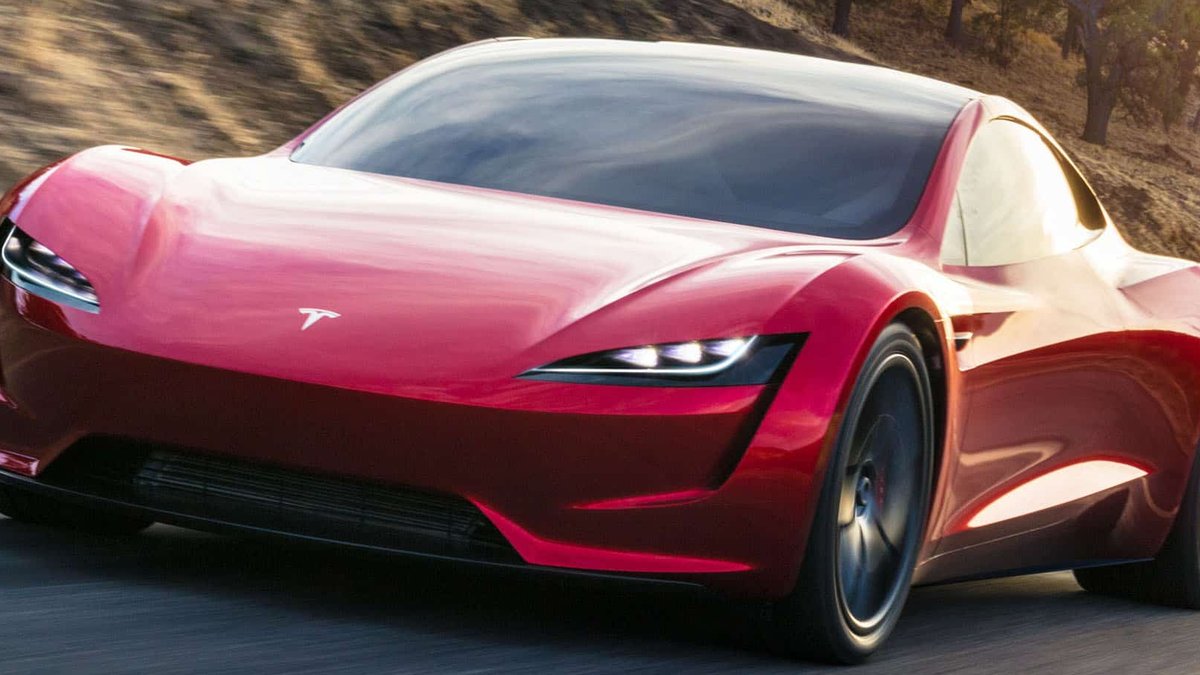
Tesla has postponed the official unveiling of the 2026 Roadster by two weeks, moving the event from 1 October to 15 October. The company cited severe weather forecasts in central Texas as the reason for the delay, noting that the demonstration could only be held outdoors. This detail has revived speculation about the long-awaited SpaceX thruster package.
Weather and venue
Invitations and reporting have pointed to the Waco and McGregor area, close to SpaceX’s rocket development site. Tesla has not publicly confirmed the final venue or whether an indoor alternative was ever considered. The postponement impacts the event format but has not changed the production timeline, UK price, or final specifications for the redesigned model.
Current information on Tesla’s UK Roadster page remains unchanged. The site still lists 0-60mph in 1.9 seconds, a top speed above 250mph, and a range of 620 miles. These figures trace back to a programme announced in 2017. Tesla has not yet published a final 2026 battery capacity, charging rate, homologated range figure, or firm customer delivery date.
Confirmed versus unconfirmed
What is confirmed is that the 15 October event is an unveiling or demonstration rather than a production launch. Tesla’s own material still describes the car as a four-seater with a removable glass roof that stores in the boot. The roof design and seating arrangement are current claims, not final homologated data for the 2026 model.
Separating what Tesla currently publishes from what has actually been confirmed is essential. The old prototype displayed since 2017 appears to have been abandoned in favour of a redesigned design. TechCrunch, citing The Information, notes that the 2017 version is no longer the focus of the project.
Related Post: Tesla Urges Universal Road Charge in Australia
Tesla’s teaser image shows a different rear treatment with a broad light signature and more aggressive aerodynamic forms. The image is deliberately obscure, so treating every shadow as production bodywork would be optimistic even by concept-car standards. The old prototype remains a functional design, but nine years is a long time in the industry.
By 2026, the competitive environment for performance cars has shifted significantly. Rimac quotes 1.66 seconds for the Nevera R, and BYD’s Yangwang U9 Xtreme reached 496.22km/h, or about 308.3mph, in a verified production-car record run. Tesla needs to show a 2026 car rather than merely repeat a 2017 presentation slide.
SpaceX package
The SpaceX package is where normal supercar engineering begins to look conventional. Elon Musk has discussed using cold-gas thrusters associated with SpaceX technology to create forces that do not depend entirely on tyre grip. In simple terms, a conventional performance car accelerates, brakes and corners through the contact patches of four tyres. A gas thruster can create force by expelling gas, which opens possibilities that another few hundred horsepower cannot.
Production realities
Customers cannot expect a flying Roadster. The SpaceX package is a propulsion system, not a levitation device. It uses cold-gas thrusters to add force beyond what tyres can provide. That helps acceleration and braking, but it does not allow the vehicle to leave the ground. Elon Musk has clarified that the system will remain a road-going enhancement, not an aerial vehicle.
Confirmed details
These are current claims, not final specifications. Tesla has not announced a firm customer production date, UK price or battery size as part of the postponement.


