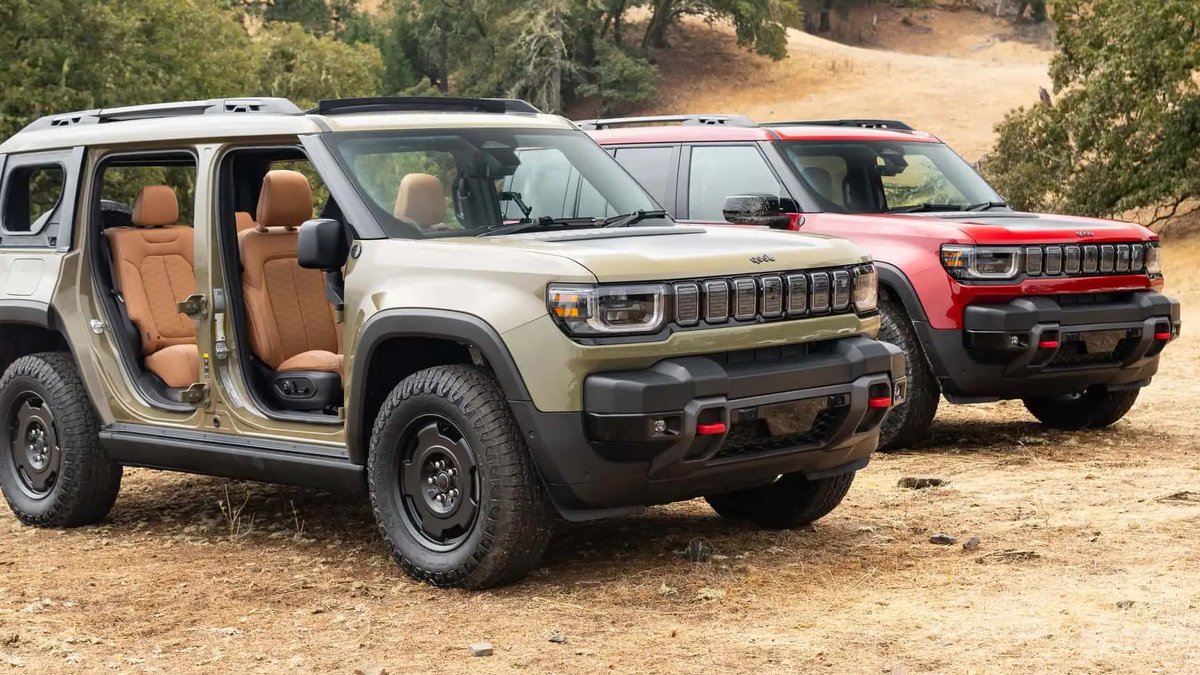
People Are Mad About The Jeep Recon’s 222-Mile Range. Here’s What They’re Missing
Range Or Capability: Pick One
If you drive a gas-powered, body-on-frame, 4×4 truck with lifted suspension and aggressive gearing, you are getting less than 20 miles per gallon. Probably closer to 10 or 15.
It’s a fact of life. Off-roaders should understand this intuitively. Tall suspension may give you more clearance when you’re rock crawling, but it drastically increases air resistance. Knobby, large, all-terrain tires are great for digging through mud, but they’re horribly inefficient at 70 mph, and loud to boot. A 4×4 system is extremely useful in slippery conditions, but any time it’s engaged it’s far less fuel efficient. Aggressive gearing increases your torque at the wheels, massively improving climbing, but the same engineering decision tends to leave your engine spinning fast and guzzling fuel when cruising on the highway.
My old Tahoe wasn’t a real off-roader, but it had 33-inch AT tires, a 4WD system with low range, and a powerful V-8 engine for low-end grunt. The result: About 13 mpg city.
These truths are why a Toyota Prius looks nothing like a Jeep Wrangler. One is optimized for fuel efficiency, and the other for off-roading. You can improve the capability of a Prius quite a bit, as you can see here: a video shows a converted Prius doing impressive rock crawling. But to do so, you have to lift it, add bigger tires, and be willing to rip off that nice aerodynamic bumper. When you do so, say goodbye to 50 mpg. Improving capability off-road almost always makes vehicles less efficient on the road.
None of this is different on an EV. High ground clearance, dual-motor designs, large tires, boxy shapes, and aggressive gearing all ding your efficiency. But many of these things are not just nice to have for a vehicle designed for off-roading; they are necessary. You cannot claim to build an off-road vehicle if it has 6 inches of clearance and thin tires.
The Compromise Jeep Made
Jeep built an EV with 6 inches of clearance and street tires. It’s called the Wagoneer S and, using the same 100.5 kWh battery as the Recon, it gets up to 294 miles of range.
Read Also: Largest LA EV Station Opens With Surprise CHAdeMO Support
But the Recon is built with some actual off-road capability. It has 9.1 inches of ground clearance, a bunch of heavy skid plates, 33-inch all-terrain tires, and a more upright design for better approach and departure angles. All of these obviously ding its range.
Then there’s the big one that most people miss. EVs may not have transmissions, but they still have gear ratios. These ratios determine how the motor delivers its torque. Taller ratios—that’s a lower first number, like 9:1 for an EV—are better for cruising and efficiency. Shorter gearing increases your torque at the wheels from a stop, but makes the vehicle less efficient at higher speeds.
Low-end torque is the whole game with off-roading, so the Recon gets 15:1 gearing on its rear motor. A vehicle with more wheel torque can climb over and push through tougher obstacles. (There’s an added benefit, quicker acceleration, which explains why the Recon can hit 60 in 3.6 seconds.) Going this direction makes perfect sense for an off-roader.
It just comes with an inherent compromise. Lower gearing hurts your efficiency, partially explaining why I saw just 2.5 miles per kWh in the Recon.
The heavier Rivian R1S tends to be more efficient than that, even if you opt for all-terrain tires. But the company doesn’t even offer all-terrain tires on models with the base 108-kWh pack. You have to upgrade to the 140 kWh version to get ATs, and even then range drops from 410 to 370 miles. That’s still plenty, but at that point you’re paying around $96,000. With taller gearing and no locking rear differential, it’s missing some of the Recon’s advantages.
The Mercedes G580 w/EQ Technology offers even more off-road capability than the Recon or R1S, with separate low-range gears for all four motors. That means it’ll climb better than the Jeep or Rivian and then switch to its higher gear for more efficient on-road cruising. But even with that clever hardware, a $163,000 price tag, and 116 kWh of usable capacity, it still gets only 239 miles of EPA range. With any of these vehicles, too, expect highway range to come in significantly below combined range estimates, as all of these factors compound at higher speeds.
What This Means For The EV Industry
So what’s the takeaway? Adjust your expectations. The path to an electric future is long and winding, and it’s become increasingly clear that the most inefficient vehicles will be the hardest to electrify. That’s why it shouldn’t shock anyone when vehicles like the Volkswagen ID. Buzz or Jeep Recon offer low ranges. Fitting an absurdly huge battery costs a lot of money, and a 91- or 100-kWh pack is hardly small.


