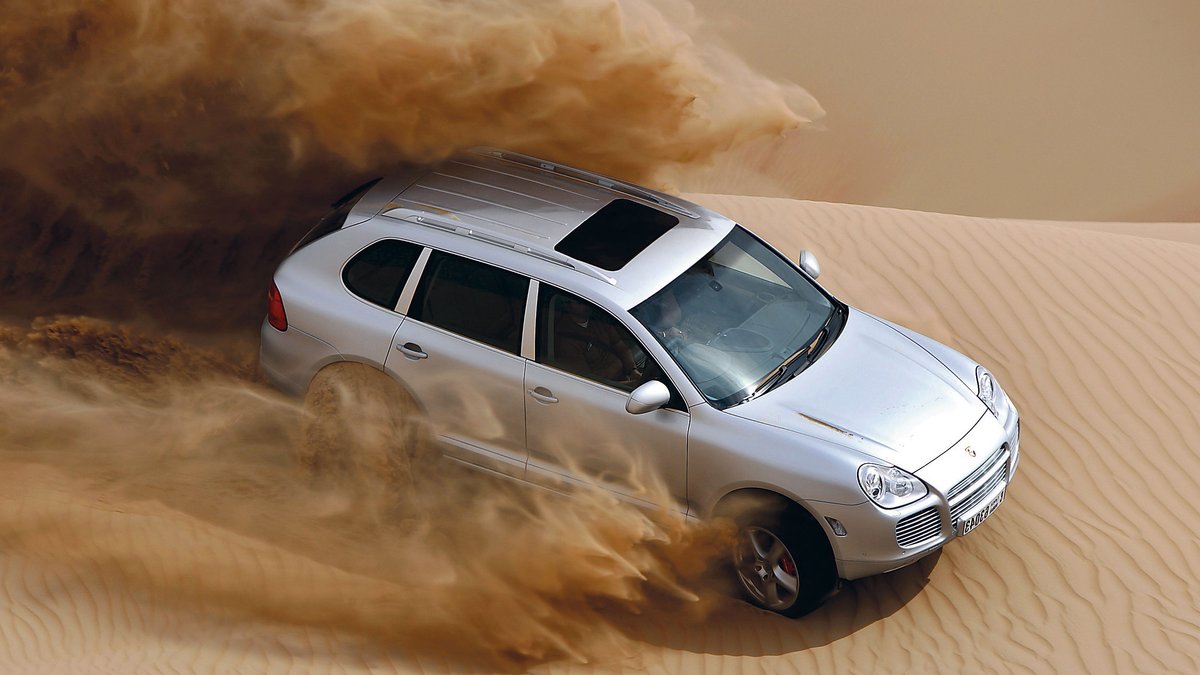
The 2006 Porsche Cayenne Turbo S combined brute force with adaptability, proving its mettle not just on highways but in the unforgiving dunes of Dubai, where its off-road systems faced their toughest exam. At launch, the model ranked as Porsche’s second-most powerful vehicle—520 horsepower and a top speed of 168 mph—trailing only the 605-horsepower Carrera GT, a hypercar nearing production’s end. Yet in Dubai, where speed limits and cameras restrained highway speeds, the real test unfolded when asphalt disappeared beneath the wheels.
The Cayenne’s permanent four-wheel-drive system, paired with Porsche Traction Management (PTM) and an air-spring suspension offering six ground-clearance settings, up to 10.8 inches in extreme mode, demonstrated its versatility. On normal roads, PTM favored a 62% rear-bias torque split, reflecting the brand’s sport-sedan roots. But when traction failed, whether on loose sand, ice, or uneven terrain, the system could lock power to the axle, or even activate a low-range gear that recalibrated ABS, brake differentials, and ride height for harsher conditions.
A second activation of the low-range switch unlocked the drive system and set maximum clearance, a feature tailored for deep dunes where wheels risked losing ground contact. Buyers could further enhance capabilities with the optional Advanced Offroad Technology Package, which added a rear axle differential lock, side skid plates, and decoupled anti-roll bars for greater wheel articulation. The package also reinforced the radiator area with a steel floor plate, a safeguard against rocks and uneven terrain.
Sand, Speed, and Suspension Trade-Offs
Despite these upgrades, the Turbo S’s 20-inch wheels and 275/40 all-season tires, rated for speeds up to 186 mph, struggled in deep sand. The solution involved lowering tire pressures, a process simplified by the Cayenne’s standard tire-pressure monitoring system and onboard compressor for quick reinflation upon returning to pavement. On paper, the Turbo S delivered 0-to-60 mph in 4.8 seconds, though Dubai’s speed restrictions prevented verification. In practice, its blend of torque, traction control, and adjustable clearance allowed it to avoid getting stuck in fine-grained sand, provided drivers applied throttle carefully to prevent deeper holes.
The SUV’s performance far exceeded that of most luxury SUV peers, even those marketed as rugged. For typical owners, its off-road abilities might serve only for icy driveways or occasional desert trips. Yet in regions where asphalt was unreliable, the Turbo S emerged as a capable cross-country vehicle. The question remained whether its $112,415 price, nearly double the base V-6 Cayenne’s $43,015, justified its dual role as both a high-speed grand tourer and an off-road adventurer.
Porsche’s Customer Center Proves the Turbo S
Porsche addressed this dilemma by offering the Customer Center in Leipzig, Germany, where new owners could collect their Cayenne and immediately test it on an FIA-certified track and a 3.7-mile off-road circuit. The diamond-shaped complex, adjacent to the production plant, featured a historical-car collection, a gourmet restaurant, and a control room monitoring every new SUV before delivery. The track itself replicated iconic racing curves, including Monaco’s Loews Curve, Laguna Seca’s Corkscrew, and the Nürburgring’s Mobil 1 chicane, allowing drivers to experience the Cayenne’s capabilities in controlled conditions.
During Dubai testing, the Turbo S’s twin-turbocharged 4.5-liter V-8 faced additional strain from deep sand dunes, where inconsistent traction tested the system’s torque redistribution. The Cayenne became mired in the fine-grained sand of the region only when we failed to apply enough throttle to plow through the deeper holes. The suspension’s six clearance settings absorbed rocky impacts without bottoming out, though the 20-inch wheels and all-season tires required frequent pressure adjustments to avoid sinking in fine sand.


