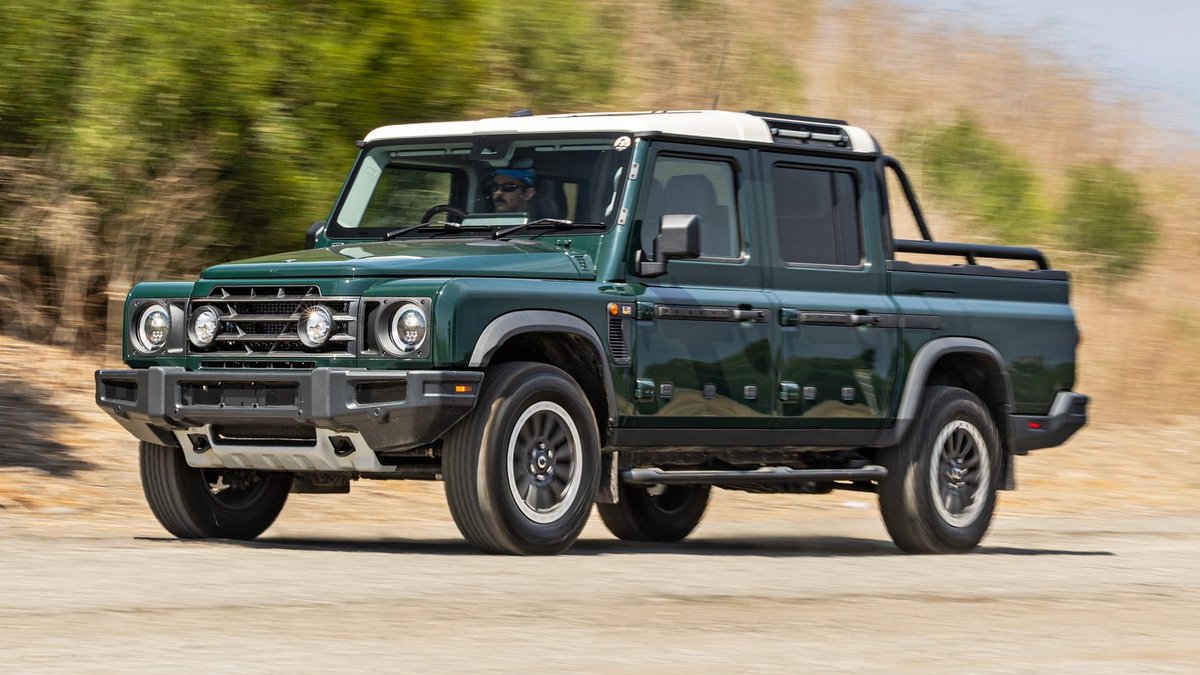
The Ineos Grenadier Quartermaster defies easy classification. It is a truck built for rugged terrain yet priced—starting at $88,295 and peaking at $97,030 for the tested model—to suggest its primary role is on paved roads. Its driving mannerisms evoke older trucks, though modern refinements keep it functional on highways. Despite its utilitarian appearance, it carries a distinct charm that sets it apart from conventional rivals.
The truck’s origins trace back to Sir Jim Ratcliffe, founder of Ineos, who sought a replacement after Land Rover discontinued the Defender in favor of the updated Defender. Unable to acquire more Defenders, Ratcliffe launched Ineos Grenadier, producing vehicles that replicate the Defender’s rugged essence while avoiding legal hurdles. The Quartermaster represents the pickup variant—a ladder-frame, live-axle truck powered by a 3.0-liter BMW inline-six detuned to 282 horsepower and 332 lb-ft, paired with an eight-speed automatic transmission.
The Fieldmaster trim level, where the test vehicle resides, merges luxury elements, such as leather upholstery, safari windows (pop-up sunroofs for front passengers), and the Smooth pack, with optional off-road enhancements like the Rough pack. This includes BFGoodrich All-Terrain KO2 tires, front and rear differential locks, and a tow hitch. The result is a vehicle that can be tailored like modular components, with features added or omitted as needed.
Performance: A Contradiction of Power and Precision
The $97,030 test model, finished in green with a white roof, embodies contradictions. It reaches 60 mph in 8.1 seconds, though only with firm throttle application. Braking from 60 mph requires 149 feet, matching the performance of the earlier-tested Grenadier SUV. Steering, once criticized as poor, is now deemed “acceptable”, though it still demands manual adjustments to stay centered. On the skidpad, it achieves just 0.59 g.
The Quartermaster’s strengths become clear off-road. On a course designed to challenge even the Land Rover Defender OCTA, the truck excels without requiring reduced tire pressure. Its high ground clearance, axle articulation, and full-time four-wheel drive with differential locks make it formidable on rough terrain. The live front axle, equipped with hydraulic steering assist, delivers a raw, mechanical feel that enthusiasts will value.
On paved surfaces, however, the Quartermaster struggles. Its firm ride quality, noisy cabin, and limited rear legroom make it impractical as a daily driver. The safari windows, while innovative, lack physical shades, and the central touchscreen controls all functions.
Related Post: Cadillac fixes Escalade IQ power door safety flaws
Design: Rugged Charm Meets Luxury Shortcomings
Despite its shortcomings, the Quartermaster possesses a character absent in other luxury pickups. Its dimensions, 212.6 inches long, 76.5 inches wide, and 5.0 inches taller than a Ford Ranger, offer practical parking, while its roof rails, bed rails, and spare tire give it a safari-ready appearance. Inside, material quality has improved, though it still lacks premium refinement. The dark brown leather steering wheel and grab handle, along with the “Toot” horn, add playful touches that feel deliberate.
The most pressing question surrounds its target audience. At nearly $100,000, it underperforms in nearly every category compared to competitors like the Ford F-150 Raptor or Rivian R1T. Yet its off-road dominance suggests it targets buyers who prioritize capability over comfort. Whether this niche is large enough to justify its existence remains uncertain.
The interior reflects a utilitarian approach. Hard plastics and thin padding dominate the dashboard and door panels, even in the Fieldmaster trim. Leather seats, though softer than earlier models, still lack premium refinement. Cab storage is minimal. Door pockets are shallow, the center console lacks cupholders for rear passengers, and the glovebox, though larger than in earlier Grenadiers, holds little beyond manuals. The space beneath the rear bench is entirely occupied by wiring and suspension components, leaving no room for tools or personal items. This reflects the truck’s design philosophy: built for what lies beyond the road, not daily convenience. The bed, however, offers a flat floor, 79.5 cubic feet of cargo space.
Off-Road Mastery Without Modern Compromises
The Quartermaster’s off-road capabilities extend to its ability to handle deep ruts and steep inclines without air-down tires, a feature rare among modern off-road vehicles. Its live front axle, while outdated by contemporary standards, provides exceptional articulation, allowing wheels to rotate independently at extreme angles. Combined with 9.4 inches of ground clearance and 22.5-degree approach/departure angles, it can conquer obstacles that would stall conventional SUVs. The hydraulic steering assist, though less responsive than electric systems, offers tactile feedback that enthusiasts of older off-road trucks will appreciate. The absence of a traditional transfer case is offset by front and rear differential locks, which, when engaged, transform the Quartermaster into an obstacle-crushing machine.
On-road, however, the truck’s shortcomings persist. The stiff ride, exacerbated by the Rough pack’s soft-side off-road tires, turns city streets into a series of jolts. Wind noise at highway speeds drowns out the cabin’s thin insulation, and the lack of sound-deadening materials makes conversations difficult. The safari windows, while novel, offer no privacy, especially at night, when the absence of physical shades turns the cabin into a symbol for passing drivers. The “Toot” horn, a playful nod to the truck’s utilitarian roots, stands out as one of the few intentional touches, though its volume is barely audible over the engine’s growl.


